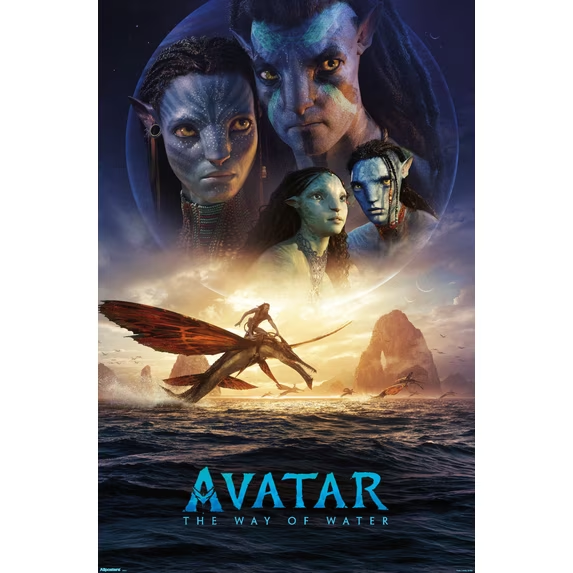
I revised my Suggestion Schedule to account for some problems my initial iteration had. Throughout February I got so much more done, wrote many more scenes, worked out a greater number of world building articles. It wasn’t perfect, and it did suffer from a few days of ‘I just need a break’ where I did almost nothing off my list, but it was one of my most productive months in a long time.
It’s not perfect. I didn’t publish any blog posts or watch any movies. So I’m still tweaking and revising the process as I’m continuing.
Projects
My focus on The Colonel Lieutenant paid off, as I’ve worked out a lot of the issues and sequence of events that have been plaguing me and added a few key scenes. Now I’m at the point where I’m sitting down to write out the rest of the scenes and see if they work. The same with Orcfyre.
I’ve been writing scenes for the 1st Minnesota book, and it’s fun to finally get this one to the page. It’s also a bit nerve racking. I’ve had this project on my mind for over a decade, and I’ve researched it and investigated, yet I also know how much more I could research. To finally get words down and start seeing things take shape is to challenge the perfect story I’ve had in my head.
Other projects are coming along. With the suggestion schedule, I’ve advanced everything, and figured out a number of stories that I’d been stuck on or indecisive about.
March Goals
The Colonel Lieutenant: Write Ten Scenes
Orcfyre: Finish One Act
1st Minnesota: Finish One Act
Other Projects: Finish One World Building / One Scene Each
Publish One Blog Post
Books
The Bearer of the Black Staff (Fiction)
The Great ‘What Ifs’ of the American Civil War’ (Non-Fiction)
War and Peace (Fiction, Audiobook)
Seven Basic Plots (Research)
Mr. Lincoln’s Army (Non-Fiction)
Image courtesy of Wikipedia
I finished two books in February.
The Bearer of the Black Staff was okay. It was several centuries after the last section of books in this series, and it’s more of a fantasy novel than post-Apocalyptic. But it just wasn’t very exciting. I’m really hoping when I get back into the Shannara books that I read back in Middle School that they’re better than I remember.
The other, The Great ‘What If’s’ of the American Civil War, I found really disappointing. It brought up a lot of interesting questions and possibilities, but the discussion about what could have happened fell really flat. There were only a handful of bits of information I thought were interesting enough to remember; the rest wasn’t enough to record. Oh well, I can’t love every book I read.
Still plugging away at War and Peace and Seven Basic Plots, which are both large books (and remember, I’m taking notes on Research books like Seven Basic Plots, so it’s slow going). On the plus side, I’m over halfway done with both, so downward slope.
March Goals
Finish one fiction book
Finish one non-fiction book
Ten chapters of Seven Basic Plots
Movies/Shows
Image courtesy of HBO
A Knight of the Seven Kingdoms
Starfleet Academy
Stargate SG1
Foundation Season 1
Star Trek Discovery (Rewatch)
To start with, A Knight of the Seven Kingdoms is fantastic. I loved it. A short-scope story of a knight making a name for himself at a tournament, with great supporting characters and amazing drama. The first GOT show I really got into and look forward to rewatching. I recommend this show to everyone.
I continued through several episodes of Starfleet Academy, which I continue to enjoy. It’s not the greatest Star Trek show, but it could be a lot worse. I also re-watched the first four-seasons of Discovery so I can knock Season 5 out and finish that show off.
To my surprise, I didn’t watch any movies this month. I thought I would get down for one or two, but time and other projects got away from me. Oh, well.
March Goals
Watch Three Movies
– One Missing Best Picture Winner
– One ‘Background’ Movie
Finish Three Seasons of TV Shows
– One Season I’ve started and Haven’t Finished
– One of a Series I want to Finish
Games
Surviving Mars: Relaunched
Star Trek Voyager – Across the Unknown
Horizon: Forbidden West
Hogwarts: Legacy
Image courtesy of Wikipedia
Star Trek Voyager – Across the Unknown is inspired by the 90’s television show of the same name. It is a procedural game where you command the starship USS Voyager as it travels thousands of light years across the galaxy to return home. I really like this game. Not only does it take from various storylines of the show, but it gives you ways to experience the storylines differently, to see different outcomes and different endings. And since the game generates different maps and sequences, you’re never going to play the same game twice.
RPG-wise, I recently ran a playtest of Delta Green as a World War 2 Commando game, with heavy combat. It went really well. The players all had fun, and though there were casualties, it felt like a World War 2 battle. Well, at least like a movie of a WW2 battle. Maybe I’ll revisit the system in the future.
March Goals
Don’t worry about playing more or less. Just enjoy the games you play.
What’s Next
I’ve got two events coming up in the next few months. I have a table at Minicon 59, and I should have a table at Quantum-Con 4, I’m just waiting for confirmation. Even if I don’t have a table at Quantum-Con, I’ll be heading there for at least some of the convention as an attendee.
Hi, friends and readers. January was exhausting, between work, writing, winter and ICE. But we made it through to the shortest month of the year. Yay us.
Overall, January was still pretty good. My suggestion schedule continues to be a valuable tool in keeping myself going. That being said, I want to be doing more with it. Not just scratching at a project to mark it off for the day, but getting real work done.
Hopefully, come March 1st, I can have some real advances to announce.
Projects
I advanced in every project this month, adding scenes to the text or entries to the world building. I gave myself permission to jump around the projects, not just writing from the front but hitting the end and middles as I wanted to. Anything to make sure that I was adding to the project.
And I did, just not to any great extent. As much as I got done, a lot of it felt like picking at the edges. I need, NEED, to get major work done.
February Goals
The Colonel Lieutenant: Finish One Major Section: Before the Campaign, The Campaign, or After the Campaign
Orcyfre: Finish Two Acts
1st Minnesota: Finish Three Chapters
Minor Projects: Finish 20 Things
Books
The Great What-If’s the American Civil War (Non-Fiction)
Bearers of the Black Staff (Fiction)
Seven Plots (Research)
War and Peace (Fiction, Audiobook)
I read a lot more this month than I did in December; still didn’t manage to finish any titles. I was tempted to start some new ones just to add to the list, but that felt like it’d just overload the list.
February Goals
Finish Great What-If’s
Finish Bearers of the Black Staff
Get Past Chapter 25 on Seven Plots
Movies and Shows
Image courtesy of Wikipedia
Final Countdown
Troy (Director’s Cut)
Stargate SG1
Foundation
A Knight of the Seven Kingdoms
Starfleet: Academy
Wonder Man
I watched a movie that several people were surprised I hadn’t seen before: The Final Countdown, a film about the US aircraft carrier Nimitz time traveling from 1980 to the day before the attack on Pearl Harbor. It was a fun movie, that had some intriguing debates about responsible actions for time travelers. But by the end of it, I was surprised how little actually happened. Still, fun.
I also watched the Director’s Cut of Troy (2004). Now, Troy has always been a movie I’ve really enjoyed. Not top-ten, but close. This edition added a lot of background, nudity and violence, particularly during the sack of Troy itself. While some of the scenes added to the story (especially the discussions amongst the leadership of Troy), most of it I understand why it was cut.
Started a few new shows this month. Wonder Man, an MCU show I know nothing about, but it has Ben Kinglsey so it’ll probably be good. There’s a Knight of the Seven Kingdoms, a Game of Thrones show of limited scope that I’m enjoying immensely.
And finally, Starfleet Academy. My first reaction to the first fifteen minutes was very negative: I was very upset at the main character. ‘A guy who doesn’t want to be here, who can overpower a shuttle of guards without too much effort, oh come on.’ But by the end of episode two, he’s eased up on whatever bugged me about him. And the fact that episodes three and four followed different students really endeared me to the show. Lets see how it ends.
February Goals
Two Movies
Finish Three Seasons
Games
Horizon: Forbidden West
Hogwarts: Legacy
Surviving Mars: Relaunched
I continued to play through all three games. Slowly, though, as quite frankly, as much as I enjoy video games, binging them for more than a few hours just makes me feel like crap. So, I have to be careful, because if I don’t pay attention, I can inadvertently spend an entire day doing just that.
February Goals
Finish ONE GAME
What’s Next
I’ll have a table at Minicon 59 on Easter Weekend; I’ve got feelers out for other events, but it might be another few months before I can add more to this list.
PBRG is a process that’s meant to make broad elements of the story and prepare them ahead of time to keep it consistent. It’s meant to remove the amount of time in proofing and editing where I’m hunting through my stories looking for every instance of ‘lightyear’ so I can change it to ‘light year’. It’s not meant to completely replace writing in the creative process, because let’s face it. It can’t. I’m still, at my heart, very much a pantser.
What’s a Pantser again?
Many writers will fall somewhere on a spectrum of being a Planner or a Pantser. Planners prepare everything ahead of time: outlining their story, preparing all their characters, doing all that extra leg work a story needs done. For them, when they start writing they already know what’s going on, so they write to the plan.
Pantsers tend to be more disorganized. It’s not that they won’t have an outline, but it’ll be more of a guide rather than a required course of action. For them, inspiration comes in the moment, and entire plots can appear to them as they’re working.
I’m a pantser. A lot of my inspiration comes during the writing. It always has. Even as a game master in RPG’s, I rely on in the moment decisions within the constructed framework to build the story. As a writer, there’s so many aspects I can’t write until I’m in the scene, hitting the thousand and one minute details that writers have to deal with.
I can world build and plan and plot and game out all I want, but at the end of the day, the writing is where I’m most creative.
Creating from scratch; the pantser way.
Where PBRG helps and falls short
I’ve found planners fascinating. Their outlines and can be so in depth as to be intimidating. There are times — usually when I’m at the end of the project and I’m coming through the text trying to iron out inconsistencies — that I wish I could do the same.
PBRG isn’t quite a planner’s outline. It is a tool I use to answer big questions before I get into heavy writings. It’s meant to ensure consistency and that I have some idea where a story is going. It’s not meant to replace my process, but to supplement it.
So far, I have found it incredibly helpful. I have prepared maps for multiple projects so I know names and travel times ready to go. There’s also character names. I can get really weird about making sure a character has the right name, so getting that done ahead of time is great. Unit names, ship types, laws and rules… many instances where PBRG helps me prepare important information ahead of time.
But it’s not writing, and it can’t take over my creative process. My writing is where I get into my character’s heads and see the events through their eyes. Where they become more than just a collection of notes, and where they get to influence the story. Planning in any capacity helps, but only to a point.
The Benefits of Writing
There are several benefits to keep writing during the PBRG process.
First, writing requires a different set of mental muscles. In world building I’m a historian; in writing I’m a storyteller. I approach the subjects differently and see things in a different light, usually the characters. What i hadn’t figured out as an author may suddenly snap into place when I’m trying to consider the problem from the character’s point of view.
Second, I cannot possibly outline and plan for every aspect of a scene. I may know what I want the scene to do (inform the reader or advance the story), but I cannot anticipate the minor things. I can plan the personalities of five friends, but until I’m writing their first conversation, I don’t get a sense of who they really ar.
And third, writing gives me a chance to challenge what I’ve been building. Sometimes, the world building looks nice but doesn’t hold up when you try to build the story around it. So it’s nice to realize that earlier in the project when the fixes are simple.
Example
A few weeks ago, I sat down to write the opening scene to a short story. The purpose of this scene was to introduce the character and the setting. Thanks to PBRG, I had the character’s names prepared, the organization of their fleet and the ships involved, and an outline for the story.
I wrote less than 800 words, but so many things occurred in those 800 words.
The admiral was no longer commanding a group of ships while defending a star system. Now, she was an admiral facing promotion and relegation to a desk job, never to command in space again. She wasn’t just fighting for duty; she had a chance to prove her value and perhaps gain a rare and coveted position. This made her bolder — and perhaps reckless.
I’d also realized that the outline for the battle was deeply flawed, not only tactically but thematically. There was no tension. Things moved as set pieces. As I had the staff officer brief the admiral, I realized how bad the plan was.
But writing the briefing exchange, I also figured out how to make it better. I would need to re-work the math I’d prepared, but there was now a time limit that made every choice matter. I still had a lot of the product from the PBRG process, but I’d refined it and was working on a better story.
‘But what’s the plan?’
Do I need another letter?
No. As amusing as it might be to try and shoehorn a W into the PBRG acronym, at this time I’m not planning to do so. In part because I think it defeats the purpose of the PBRG system. But also, because I won’t always know what I want to write, or need to write, or am inspired to write.
What I can do is just acknowledge that the two need to work together. PBRG provides the framework for the project, answering the big, long-term questions I need to know. Writing allows me to check the framework and build the facade. Back and forth. Until I have a finished project.
Then I get an editor to hit it with a wrecking ball, and we see how it stands.
I’m hitting 2026 running. Thanks to my suggestion schedule, I’ve been progressing on all projects. I’m reading and watching and gaming more, and I’ve got events lined up (or at least potentially lined up). I’m feeling optimistic.
Projects
I’m closing in on a new draft of The Colonel Lieutenant. It’s been a process of writing from both ends and cross-checking my information. I’m going to start tackling the big campaign in the story soon, which means maps and gaming out movement and action.
I’m also progressing with Orcfyre. This one I’m also tackling from both sides, because I know how I need it to end, but I’m not sold on the start. So, we’ll see how that goes. As much as I want this one done, I want it to be done right.
In addition, I started writing the first scene of my 1st Minnesota book. This is a real interesting challenge from a writing perspective, because this is a historical fiction series. I don’t need to do so much world building as I do need to check several historical records.
And, finally, I’m getting work done on all my other projects. The suggestion schedule has been really nice to keep things moving each day. Even if all I do is write a few paragraphs or work out some aspect of the world, it’s still progress.
January Goals
The Colonel Lieutenant: Finish two acts in progress
Orcyfre: Finish two acts in progress
1st Minnesota: Finish two scenes and check with books
Minor Projects: Write 12 scenes
Minor Projects: Finish 12 world building goals
Books
Seven Plots (Research)
Bearer of the Black Staff (Fiction)
Cardinal of the Kremlin (Fiction, Re-Read)
War and Peace (Fiction, Audiobook)
The Great “What Ifs” of the American Civil War (Non-Fiction)
I did not finish any books in December. Reading is one thing where I want to work on doing more of while I wait for summer to bring back my reading porch. I have a reading chair downstairs, and several ebooks so I can read from my phone if I don’t have access to the physical book.
January Goals
Finish one fiction book
Finish one non-fiction book
Finish one research book
Movies / Shows
Superman
Sisu
Stargate SG-1
Foundation
Stranger Things (Season 5)
Image from Wikipedia
I saw two movies last month. Both of them I liked.
First was the 2025 Superman film. I appreciate that this film avoids spending time telling us Superman’s origins or having him play secret identity with other characters. Having other superheroes in the film helped. And I think Nicholas Hoult as Lex Luthor is my favorite rendition of the character so far. He wasn’t as comical or over the top as previous iterations.
Second was Sisu, a Finnish action thriller set in World War 2, about a Finnish prospector fighting Nazis. This film was over-the-top, with little or no character development. Just action and ‘that wouldn’t work’ thrills. It was fun. And at one point I cheered. Good times.
And as for TV shows, I did make time to watch and finish Stranger Things, Season 5. I was curious to see how it ended, and I thought they did a great job. Things ended about as well as they could for most of the characters without breaking the story. There were a couple of instances in the finale where I started to wonder if they were warming up for this curveball or that one, which I appreciate because that means the story was robust enough for it to be a possibility. And maybe I had one or two questions about how things wrapped up that weren’t addressed. But, overall, I really liked it. And I’m sure there will be dozens of posts across social media about how I’m wrong, but so what. I liked it, and I’m okay liking it.
January Goals
Watch two movies
Finish two seasons of TV Shows
Games
Last of Us 2 (Re-play)
Hogwart’s Legacy
Battlestar Galactica Deadlock
I managed to finish my Last of US 2 replay in time for the New Year. That’s a relief. at some point I can go back and replay to get achievements and pull easter eggs, but for now I can focus on other story games.
While I get back into Horizon Forbidden West and Red Dead Redemption 2 on the consol, my next PC story game is Hogwarts Legacy. Taking place a century before the main books and movie, the story follows a Fifth-Year student involved in some mystery. So far, I’m enjoying the game and the world, and the combat system is fairly dynamic. My only complaint is the sorting hat simply asks you what house you want to be in. I was hoping that it would be a series of questions to determine what playstyle you want, so you can replay the game several times as different types of characters. But apparently, house choice doesn’t impact the game all that much. Too bad. Feels like a lost opportunity.
January is going to be my first month of ‘Open Game Goals.’ When I play an open game (one that doesn’t have a story) I will play with a set objective in mind, such as get an achievement or win as a specific faction. That way, I don’t start without any end point in mind, which can be annoying depending on the game.
What’s Next?
I’m the waitlist for several events in 2026. I believe I have a table for Minicon this year (I’m just waiting for confirmation), and there are a few conventions I’m keeping my eye on for the applications to go in. When I start having things scheduled, I’ll add them to this entry.
2025 comes to a close. It’s been a big year, with lots of challenges, successes and failures. I published, read, watched and gamed. I’ve written, drawn and programmed. I’ve met some goals, and missed others.
Overall, I’m glad with how 2025 turned out. Maybe I could have done a lot more, but I also could have done a lot less. So, I am a happy author-man.
As for 2026, I’m hitting the ground running with my suggestion to-do list already keeping me productive on a daily basis. I’m excited to see how much I can get done next year.
Projects
The big project news of 2025 was publishing Champion Bold, my first science fiction novel. I’ve heard some good reviews, and I’m working on two sequel books (one direct sequel, and one following a popular secondary character).
There isn’t a single project on my list that I didn’t work on this year. I world built or wrote important scenes. I developed characters and outlined plots. I’m looking forward to bringing more to print, and I’m hoping to get more of them to my readers soon.
2026 Goals
Major Project: Get the Colonel Lieutenant to print, or at least final draft
Major Project: Get Orcfyre to print, or at least final draft.
Major Project: Get 1st Minnesota story book 1 to rough draft
Minor Projects: Get each project to detailed outline, some scenes written.
Books
I fell short of my reading goal by a good number: I finished 14 books out of a goal of 36. But that’s largely because I’m still adjusting to not bussing anymore. In the summer I can read on the porch, but in the winter I have to make time.
Most of what I did read was fiction, either from my Tom Clancy re-read or from the Shanarra series I’m slowly working through. I most disappointed I haven’t finished more of my research books, particularly Seven Plots. But, we move on.
2026 Goals
Finish 24 books total
Finish audiobook of War and Peace
Finish 3 Research books
Finish 6 Non-Fiction books
Movies and Shows
I finished 18 movies and 11 seasons of TV shows in 2025. I’m happy with the number of movies I finished, but a bit disappointed I only for through 11 seasons. That’s less than one a month. My lists of both are long and getting longer, so this is definitely something I want to get better on.
2026 Goals
Finish 24 movies (2 a month)
Finish 18 seasons of shows (1.5 a month)
Games
I only finished 3 story games in 2023. Now, this isn’t a lot, but it doesn’t take into account open games (games without stories). those game I could replay multiple times without really finishing them.
For 2026, when I start an open game, I’m going to set myself a challenge. Something like ‘get these achievements’ or ‘win as this faction’. That way, I have a set goal that I can reach, and when I reach it I can move on, and always comeback to replay for a different challenge later.
The way I incorporated the games into my suggestion list (one day is story game, next day is open game, then back) helps immensely.
2026 Goals
Finish six story games
Finish ten open challenges.
Events
I managed to get to two conventions, two brewery events, and my launch party this year. That’s not bad. I’ve got one event for sure lined up in 2026, and several others I’ve got my eye on or I’m on waiting lists for. I’m considering bringing back Book and Beer, if only to keep myself going to events. We’ll see how that goes.
November went well. I continue to benefit from the use of the daily recommendation schedule. It’s nice to know that if I have time to work and I’m not inspired by any particular project, I can look at this schedule and work on what it suggests. And if I am inspired to focus on one thing or the other, I will do so.
Projects
I got at least something done for each of my projects. Either I completed one of the world building tasks, or I write a scene to start fleshing out the story. Very nice to start knocking those goals off.
With the Colonel Lieutenant I got at least rough drafts up to Chapter 20. Every time it’s on my list I’m picking at it, getting it closer to being done. I am a little worried it might get too big; maybe I need to cut it into two? I hope not, but we’ll see.
Most of my Orcfyre work was world building. In particular, I focused on fleshing out the pantheon of deities, especially as the main characters would know and interact with them. I started the first scene and I’ve outlined much of the rest.
As for the 1st Minnesota project, I did come to a decision to write this story in the First Person. I think, ultimately, this is the better way to get the experience of the soldier across to the reader. And there are mechanisms I could use for a third person perspective if I needed. But, we’ll see.
December Goals
The Colonel Lieutenant: Finish 5 Acts
Orcfyre: Finish First Act
1st Minnesota: Finish First Act
Other projects: Write at Least One Scene Each
Other projects: Cross off at least one World Building goal Each
Blog Post: Still a Pantser
Blog Post: Writing Process – Research
Books
Seven Plots (Research)
Bearer of the Black Staff (Fiction)
Cardinal of the Kremlin (Fiction; Re-Read)
Didn’t get too much reading done last month. It’s something I want to change in December. Dedicated reading time every day.
December Goals
Finish one of the Fiction Novels
Finish Seven Plots
Start New Research Book
Start New Non-Fiction Book
Movies / Shows
Image courtesy of Wikipedia
John Wick
John Wick, Chapter 2
John Wick 3 – Parabellum
John Wick, Chapter 4
Ballerina
Foundation
Stranger Things Season 5
I watched through the John Wick movies last month. I thoroughly enjoyed them. The entire series was a master class in world building. We learn so much about the world by watching the story play out. When they can’t show us, they only tell us enough to keep the story going, without revealing more information than they needed to. The fight scenes were fantastic and well choreographed (though I think they started to draw a little long by the fourth movie).
I then watched the spinoff Ballerina, which is set between Wick 3 and 4. This movie was just as exciting and fun as the original series of movies. And I appreciate that the main character (Ana de armas) fights differently than John Wick (Keanu Reeves), as she’s a small woman and not a moderately sized man. I can see why everyone likes this series.
I also got too start the fifth season of Stranger Things. This show has been a favorite of mine for a long time, and the first four episodes have shown the magic continues to grow. I’m excited to see what they have in store for the last episodes.
December Goals
Finish Foundation Season 2
Finish Bad Batch Season 2
Finish Stranger Things Season 5
Watch two new movies
Games
Madden 2026
Last of Us 2 Replay
Sniper Ghost Warrior Contracts
Surviving Mars Relaunch
I didn’t spend much time on the couch in November, so my console games remain unfinished. Nothing wrong with that, except for the normal crossing things off my list part.
I did start a PC game called Sniper Ghost Warrior Contracts, which is a sniper first person shooter set in Siberia. It was okay, but it didn’t really draw me in. I kind of stopped playing it. I may come back in the future and finish it off, but if I don’t, I’m okay with it.
Then I started to play the Surviving Mars Relaunch. It’s a remaster of the game Surviving Mars, which I spent a lot of time playing. I haven’t noticed too many differences yet, but I just got into it Thanksgiving weekend. I’m eager to start playing the new stuff soon.
December Goals
Finish Last of Us 2 Replay
Start new PC Story Game
Get back into Horizon: Forbidden West
Get back into Red Dead Redemption 2
What’s Next
I’ve got a event lined up for December 20th, 2 to 5 PM, at Utepil’s Brewery. Only a few hours to sell some books, but it’s something.
Still on some waiting lists for other events. We’ll see what come sup.
In the year since I last told myself the cake calories didn’t count, I have managed a number of steps forward. I published my third book, Champion Bold, and its three supplements. I did two conventions and one book event, all of which were successful. And I made progress on several other projects. It was a good year. One I’m hoping to continue into the next.
As I hit my birthday, I wanted to take a moment to consider my project list. What am I working on? How important is it? And what do I need to do to advance it before the next birthday?
Primary Projects
Primary projects are the major projects that I’m actively trying to get published. I have at least one completed draft and I’m rewriting or editing for publication.
The Colonel Lieutenant
Renaissance Army Book 3 * Dystopic Speculative Fiction * Renaissance Army Setting
Book Three of my main series, this book sees Sasha Small, now a commissioned lieutenant of the Renaissance Army, return to the Third Field Regiment in a moment of crisis. She is faced with a test of leadership and of her skills as a military officer.
I completed one draft of this book and I’ve been working on the next. I’ve got the first quarter or so done, and I know how I want it to end. But getting from A to Z and making sure the letters in between build it effectively is the real challenge. I’m making good progress. Now if I can make fast progress.
Orcfyre
Horus Book 1* Fantasy * Vi-World Setting
This first book of a planned trilogy. This book sees Horus, a human/orc warrior, and his adopted sister Ashlynn, on a quest. A quest that could save Horus’ life. Their adventure is interrupted by a civil war that forces both of them to face the truth about their relationship with the world.
I’ve gone through several drafts of this story, slowly working out my problems with each iteration. Do I have it this time? I think so, but if not, then I think I’ll be closer to the last draft.
Secondary Projects
Secondary Projects are projects that I want to publish. These ones I’m writing to get a rough draft ready, looking to get feedback on.
1st Minnesota (Untitled)
Historical Fiction
This project is the story of a soldier who enlists in the 1st Minnesota Regiment at the start of the American Civil War and fights through its three-year service. The character experiences Bull Run, the Peninsula and Seven Days, Antietam, Fredericksburg and Gettysburg, and so much more.
I’ve got lots of research notes and books on the subject. I know it’s going to be more than one book, though I haven’t worked out the exact divisions. I’ve got everything ready to start writing. What I need to figure out is first person or third. Or some hybrid of the two.
Tertiary Projects
Tertiary Projects are projects where I have the idea developed and I’m focused on running through the PBRG process and writing key scenes.
Champion Impact
Champion Book 2 * Science Fiction * Light Star Universe
The sequel to Champion Bold, this story follows Augustine de Zama in his adventures. Since the first book was funded through Kickstarter, I need to get info from some backers on aliens and characters, then I can slip them into my outline and start hammering out the story.
Dress Reds, Inc.
Champion Series Spin Off * Science Fiction * Light Star Universe
A spin off from Champion Bold, this book follows Genevieve Wright, a fan favorite. Genevieve is hired to go to a region under an emerging threat. But in addition to warfare, she finds herself dealing with the politics and cultures — and alien species — of the region.
Light Star Short Story Anthology (Untitled)
Science Fiction * Light Star Universe
This anthology is a collection of short stories from the Light Star Universe. If this works the way I want it to, it’ll include three stories from myself, and two stories from the LSU co-creator. But we’ll see how it goes.
Retirement (Untitled)
Fantasy * Unique Setting
Retirement is a fantasy story set in a world where the gods must choose mortal replacements every century. The hero has been chosen to be a god, a distinction he does not want. But since he’s been chosen, he now has to deal with the consequences or face the annihilation of his soul.
Quaternary Projects
Quaternary Projects are projects that I developing. I’ve got more than a basic idea, but short of an actual story. I’m doing some light PBRG work to help flesh out the details.
Commonwealth War
Speculative Fiction * Renaissance Army Setting
A book or books about the Commonwealth conquest of Atlantic America, set well before the story of Sasha Small. In the same style as Tom Clancy’s Red Storm Rising, with multiple characters showing different aspects of the war. I know the history, but I need to work on the characters and plot lines.
Conarth Story
Science Fiction * Light Star Universe
A story of the Light Star Universe, this book involved the Conarth, one of my major alien races in the universe. I don’t want to go into too many details right now, but this will be an interesting project because it’ll be largely a political story with a military backdrop. Looks like I’ll be watching a lot of West Wing.
Contrition (Untitled)
Dystopic Science Fiction * Contrition Setting
This is a setting where I’m looking for a story. The setting is thousands of hears in the future, after an alien race has devastated humanity and left it in ruins. The aliens declared that humanity had ‘reached Contrition’, but never told humans what they had done. I have some ideas, but trying to come up with a story that isn’t repetitive of what I’ve done before has proven difficult. Plus, I want a story that explored the setting.
First Knights (Untitled Project)
Fantasy * Vi-World Setting
This is a story of how the knightly or paladin orders of the Vi-world started. I’ve had to build and really flesh out the mythology of the world to set this one up. Now, I’m outlining and plotting.
General of the Pen
Fantasy (I think)
This is the project I’m building as part of the PBRG blog series. It’s a fun project and maybe I’ll turn it into an actual book. Or maybe not. At this point, it’s just for fun. As for the genre, it is 19th Century tech level, but no magical elements, so I’m unsure if it is fantasy or not. Something more to research.
Resurrection (Untitled)
Science Fantasy * Apex Setting
This project is set in a world where some humans have developed special powers. The main character has been resurrection after his execution because it turns out he was innocent, and the powers that be need his help finding the real culprit. But being executed while innocent doesn’t do much for one’s dedication, and he begins to plot his escape. I’ve got the beginning written, and I know where this ends. Currently, I’m plotting out the middle.
Tales of the Templars
Speculative Fiction * Short Story Anthology * Renaissance Army Setting
This is a project I come back to every now and then; a collection of short stories about the other Templars from the Renaissance Army series. About how they came to be part of the project, and their experiences as apprentices. I’ve got one story done, several others started, and the rest plotted out or at least outlined.
Quintenary Projects
There are projects that I have as ideas. I sometimes work on them, but largely they’re waiting for time, or for more inspiration.
RPG Lit: Stories of role-playing games stuck in their characters.
Battle Stories: Narratives of famous battles (such as Jutland and Operation Pedestal).
Good Generals: Narrative biographies of good generals many people don’t know about (such as George Thomas and Winfield Scott).
Bad Generals: Narrative biographies of bad generals (such as Charles Townsend and Rafael Cardones).
Campaigns: Narratives of famous or not famous campaigns throughout history (Burma campaign, or the Winter War).
War Stories: Narrative of not so famous wars (such as the English Civil War or the Seven Years War).
Ship Stories: Stories of the history of famous warships (USS Enterprise, HMS Warspite).
Wars of the Renaissance History: Various histories of the Iron Republic, or the Imperial Commonwealth
Special Action Force Vanguard: A World War Two story I ran as an RPG a long time ago; I’d like to bring it back as a story, but I’m working out how. Cthulhu-horror? Straight military history?
Other Vi-world fantasy stories: various stories set in the same fantasy world as Orcfyre and the Firt Knights project.
I said in the October update that I laid out a schedule for the month. And until I got distracted by a Fiverr project, it went really well. I watched shows, knocked chapters and world building goals off my list, and drew. Then someone bought a Fiverr goal and that took up a lot of my time; I only really kept at the Inktober drawing schedule. But it was useful enough that I’ve decided to make one for November as well. This is not a draconic ‘you must do everything every day’, but more of a ‘if you have time to wonder what to do, here is what you’re going to do.’
Project Work
I added another chapter to the Colonel Lieutenant, but more importantly, I planned out several important plotlines for the middle section of the book. This is good because while I know the broad strokes of the ending, the details have alwyas been mush because I haven’t had them set up in the middle. Hopefully in November I can knock some chapters out and get it closer to publishing.
After a log of plotting and planning, I started the next and hopefully last re-write of Orcfyre. This outline addresses my issues with the last one, and has extensive world building thanks to the PBRG system to support the story. Now it’s just knocking out word.
I’ve added support documents to other projects, from geography work to pantheons. In November, I want to add at least one chapter for each project, so I can get a sense of the characters on the page.
November Goals
Get The Colonel Lieutenant to 20 Chapters
Get Orcfyre to 10 Chapters
Get one chapter for each other project
Publish two blog posts
Books
Seven Basic Plots (Research)
Bearers of the Black Staff (Fiction)
The Cardinal of the Kremlin (Fiction; Re-read)
War and Peace (Audiobook)
I didn’t reach much this month. I meant to, but it didn’t work out that way. Instead, I only managed to knock out a few chapters of each book without finishing any of them. No excuses not to do better in November.
November Goals
Finish One Fiction
Finish One Non-Fiction
Finish One Research
Movies / Shows
Image courtesy of Wikipedia
Foundation Season 1
Star Wars Bad Batch Season 1
The Thing from Another World
The Thing
I finished the first season of the Bad Batch, the Star Wars animated show. This is doing a good job of showing the transition from Clone War to Imperial Army, There’s enough of a mystery to keep me interested, enough action to keep it exciting, and enough world building to keep me attached.
This Halloween I ended up doing a horror movie double feature. I’m not much of a horror movie guy, but enough of my friends love the 1982 The Thing movie that I said I would watch it this month. And my dad, being a movie connoisseur, said I should watch the 1951 The Thing from Another World, so I made a movie night of it.
The Thing from Another World is a fun movie. It’s about a US science expedition to the north pole that finds an alien life form in the ice that comes alive and tries to kill them. The movie is more than 70 years old, so there are several dated aspects, but they in no way detracted from the movie. The dialogue was fun to listen to (very fast paced and overlapping). And most of the characters were less stereotypical than I expected. I was a good movie to start the double feature.
The Thing is a different movie. The expedition (to Antarctica this time) doesn’t find the creature but encounters it. The creature is a chameleon instead of a straight up monster, and the tension of the movie is less about beating the creature than it is about the trust or mistrust of the characters amongst themselves. The effects are great. It was a fun watch, and I see why people like it so much. The only distraction was trying to figure out where I’d see so many of the actors before.
November Goals
Watch three movies
Finish Foundation Season 1
Finish Two other Season of TV
Games
Image courtesy of Wikipedia
Dune: Spice Wars
World of Warships
Last of Us 2 (Replay)
Madden 26
I started a new game; Dune: Spice Wars, which is a RTS game set on Arrakis in the Dune universe. It’s a good mix of resource management, strategy, politics and covert actions. It’s scratching that strategy itch of mine, but it doesn’t have much of a storyline.
Other than that, I played through more of the other ones. Not much to add, really.
November Goals
Start a PC Storyline Time
Finish Last of Us 2 Replay
Get back into Horizon Forbidden West
What’s Next
I’m on the wait list for several events coming up or in 2026. As things become official I will have them posted.
Magic, science and mythology are three broad categories to cover. Each one represents a deep part of the lore. This is getting into the metaphysics of the story, building gears that grind layers beyond what the characters do and the reader sees. They represent aspects that can influence the characters’ understanding of the world around them.
I mean, that’s a lot to put on the categories.
Not every story will need magic, science or mythology. Some might not need any of them. But if the story does require anything, I’ve found it helpful to build a framework beforehand so I can remain consistent.
After all, we don’t want to break the story, do we?
Break the Story?
Yes, break the story.
Using magic and science to solve plot problems is a time-honored tradition. But use it too much, and it becomes a joke (see Batman’s utility belt or Star Trek technobabble) and the story breaks. There needs to be a balance, otherwise the reader will be left thinking that it was too easy.
And mythology may not be about solving problems directly, but it is about how characters interact with their world. And if I build an entire mythology, only for the characters to never reference it or react to it, then the world breaks, and then the story.
I want to be careful that the rules I’m building remain important but constant. Part of that means considering what I need the system to do, and what I need it not to do.
‘So…think Michael will learn to draw hands sometime? I’d really like thumbs.’
Magic and Magic Systems
A magic system is a set of rules for extra-normal powers and abilities that can be accessed through natural talent or learned ritual. It can run from the wizards and artifacts of a fantasy story to the psionic and telekinetic powers of science fiction.
I have several projects that need magic systems. Champion Bold needed some rules for psionic powers for consistency. Orcfyre needed magic rules for not only spells, but the influence of divine power on the world. Several of my minor projects (fantasy and science fantasy)require their own systems.
The important thing I need to keep in mind while working on these systems is that I’m building guidelines. I don’t need to work out every single variation of spell that exists within the world. I just need enough that the story is consistent. With that in mind, I want to build the rules specific to the project I’m working on, while leaving enough room to build on for future projects.
Building a Magic System
When I’m devising magic systems, there are a couple of important questions I want to consider first.
What can it do and what can it not do? It’s important to set boundaries. Is magic common: have practical utility or tactical use? Or is rarer, used by the elite for grand purposes?
Who can access this system?: Not everyone can cast spells or conduct rituals. Who can do it and how they access it? How rare are magic users? What sets them apart?
How is the system received? A magic user could be accepted and protected, or they could be feared and persecuted. How are magic users incorporated into different cultures within the world?
What are its consequences? Magic should have a consequence, even if its as simple as exhausting its user. Something needs to keep magic users from using their magic on a whim.
Example System – Vi World Magic Spirits
I’m going to bring up my Vi world magic system, as its the system I’ve developed the furthest.
Vi world is a fantasy world I’ve been building for some time; it’s the setting for Orcfyre, my ‘someday this’ll be ready to publish’ fantasy novel. It has a long mythology that I’ve worked out over the years, built around the idea that the spirit world exists alongside our world. And the spirit world is where magic comes from.
Magic is what happens when spirits are pulled across the divide and used to influence the real world. This can be hurt or heal people, change an item, or seek the truth about secrets.
Asking my questions
So, let’s consider my questions.
What can it do and what can it not do?: The magic of Vi world can do almost anything, from levitating small objects to divining the future. But because of how difficult the magic is to use and control, it’s not a common. If you see someone on the street corner offering spells, it’s more likely slight of hand.
Who can access this system?: Anyone who can pull a spirit across the divide can use magic. This isn’t easy. Unless you’re at one of a few spots where the divide is weak (commonly where temples and oracles set up shot), you have to use force. That means either a natural talent due to heritage, using an item or ritual, or sheer willpower. Even then, it’s not easy.
How is the system received?: Every culture in Vi world accepts magic in one form or another; none reject or persecute magic users. But every culture also has their own set of norms and expectations, and magic users who reject such expectations can find themselves in danger rather quickly.
What are its consequences?: Using magic is exhausting, even with training. Unless an individual’s heritage (racial and familial) is inclined towards magic, even a single spell can drain a person, perhaps even unto death. In many cases, multiple spellcasters will be used to reduce the impact on any one user.
Impact in the Story
Within the Vi world, magic is a known quantity. It exists, and everyone knows it. When it happens, it has an impact. But getting it to work usually requires significant effort, so it is not commonplace. it allows me to write a story where the characters know such magic exists, but do not feel the worry that it will erupt at any time.
Magic’s rarity is in contrast to our next topic, which requires as much effort to construct, but with the expectation that it will be used far more often. Now, we will discuss science systems.
Science
A science system is a set of rules for branches of knowledge and avenues of advancement that are accessed through technology. It can run from steampunk airships and mechanical suits of a fantasy story to the energy weapons and space travel of science fiction.
Science is rooted in the real world, which makes building a science system a different challenge from a magic system. Anything I need to build will have something similar or related I need to research and incorporated. Even FTL travel — with no working real-world examples — needs to take into account the speed of light, distance between systems, and the strength of gravity.
Building a Science System
As with magic, it’s important to remember I’m building guidelines to remain consistent. I don’t need to build everything. I need to build what I need for the story, and enough extra to give it some depth. But that’s it.
And there are the questions I need to consider.
How reliable is the science or technology? An established empire will have reliable technology, while frontier societies will need more maintenance. Also, this is an important question to ask in the context of the story; if I need it to be reliable, or to fail, I need to account for that.
What does the science/technology do or not do? Just like magic, I want to consider what the technology of each system can or cannot do. There should be limits.
What is the math? Yes, there’s that math. I need to have numbers in mind for firing ranges of weapons, speed and acceleration of space ships, communications time, etc. A lot of little things that I want to make sure are consistent one chapter to the next.
How knowledgeable are most people about the science and/or the technology? Not everyone can know everything, but there’s a difference between a ship’s crew knowing the basic principals of how their engine’s work, and believing it to be esoteric witchcraft.
Example System – Light Star Universe
The Light Star Universe is home to Champion Bold, my recent science fiction novel. It’s always been a pretty standard science fiction universe; what made it special was not the technology, but the aliens and the stories we told.
How reliable is the science or technology? Most of the technology encountered in Champion Bold is reliable and known. That isn’t to say experiment tech doesn’t exist, but it’s not put into mass production if it’s not ready for use.
What does the science/technology do or not do? The technology of the LSU is generally pretty standard sci-fi fare. It allows faster-than-light travel, artificial gravity and space combat. It does not bring back the dead or teleport people across vast distances.
What is the math? I won’t bore you with equations. I will say that after I worked out the math, much of the story had to change. A couple of combat chapters were re-written to be consistent, and the length of the story doubled once I accounted for FTL travel speeds. But, overall, it strengthened the story.
How knowledgeable are most people about the science and/or the technology? It’s roughly equivalent to modern industrialized society and the technology we use on a daily basis. Most people understand the basics and the principals, but they wouldn’t be able to repair or rebuild it without some training or education.
Impact in the Story
The technology of the Light Star Universe exists to allow the stories to take place. It is not there to dramatically change things, but is a stable and reliable base which the characters can expect to do what it’s designed to do. But most importantly, it’s consistent, which means the story can advance without the reader pausing and asking ‘wait, I thought ….’
If magic is rare, and science common, our next topic is so common as to be subtly invisible. This is our last section of the post, mythology.
Mythology
A mythology system is a set of stories and beliefs that guide and influence a society’s morals, decisions and responses to the events they are experiencing. It’s a broad heading, that covers small sects of Christianity to fantasy world mythologies to alien philosophies.
(I debated using philosophy or belief system for this part of the post, but I’m going to stick with mythology.)
At first glance, you might think it looks out of place here. Mythology, after all, doesn’t give people special powers or abilities. But mythology in one way or another does shape how the characters in a story interpret the world around them and the events they experience.
Mythology was fairly minor for the works I’ve published so far. I’ve only had to build a sect of Christianity and some the cultural mythologies of some alien cultures. But having these worked out , even in their minor forms, was still important for the characters’ arc. But for future titles (Orcfyre being a prime example).
Building a Mythology
As with anything, I start with ‘what do I need to build for the story.’ Then, I move on to my mythology specific questions.
What are the important tenants of this mythology? Every mythology has something it emphasizes that makes it different from others. I want to consider a bullet list of what the mythology teaches, preaches and demands of their followers.
Who is the mythology for? Not every mythology will be followed by everyone. It could be a very elect group of people, or perhaps followed by citizens of a certain city or members of a certain species. But I’ve found defining how someone becomes a follower really helps, even if its as simple as ‘an alien mythology followed by a race of aliens.’
How do followers of this mythology act differently? I want to have some basic idea of how a follower of a mythology acts in accordance with their beliefs. More specifically, how does a follower act differently from me and what I consider normal. I also consider questions of devoutness; some people will take the beliefs as iron rules, while others will pay lip service and go about their day.
How real is this mythology? Every mythology will include myths, but there’s usually a grain of truth in the middle. Depending on the story, the grain could be pretty close to the mark, or could be pretty far off. How close it is could be a matter of contention with the world, and could be a source of conflict within the story.
Example Mythology – General of the Pen
For the example of this portion, I’m going to return to the General of the Pen, the story we’ve been developing as part of this blog series. In particular, I want to build the mythology of the Campilesian Church. I know the organization of the church from a previous post; now, I’m building the beliefs.
What are the important tenants of this mythology? The Campilesian belief system is very close to Christianity in a lot of ways. This system has a firm belief that everyone has a passion in their life, which leads to their high number of saints and grand patrons. They also are less strict on gender norms (usually) and abhor slavery.
Who is the mythology for? The Campilesian system is for everyone, from the common farmer to the ruling lord. They accept converts fairly regularly and easily. Most Campilesians live within the Campilesia region, or in a neighboring region.
How do followers of this mythology act differently? The belief that everyone can be great at something means that most followers have some passion they pursue. Some may make it the main part of their life, or it’s something they engage in outside of their profession. But they are generally supportive of everyone around them.
How real is this mythology? The basis for this belief system is an ancient philosopher who works for the survival of the Campilesian people when conquered by the Ferrans. His system allows them to survive as a people under centuries of rule by other people. The religious aspect — spirituality and afterlife — are believes, but not perfectly known.
Impact in the Story
The Campilesian religion gives the people who make up most of the characters in my story a shared belief system. A system that encourages people to find their one passion, which could be Campilesian independence. It also means that the people view the sacrifice of military service in a very high light.
Conclusion
Magic, Science and Mythology are all broad topics that I’ve bumped into during this post. In each case, I’ve provided a brief overview of what each one means and how I start their creation. The actual work would include pages of notes and histories, spreadsheets of math and lists of entries. Unique questions for each system that don’t apply to the others. A lot of work and information that the reader will never see.
With the end of this post, I’ve finished my four posts on the World Building aspect of the PBRG system. Next up, I’ll go over the Research aspect. I don’t imagine that’ll be more than one blog post, but we’ll see how that goes.
September was weird. I did a lot of work, but didn’t get a lot done. I’m not sure how that happened, but after several months of not getting a lot done, I’m pretty frustrated with myself.
So, I’m trying something new for October: I’ve made a schedule. Every day, I’ve laid out five goals: one for my Inktober challenge, one writing goal, one world building goal, one video goal, and one book/blog goal. Maybe I won’t hit every day, but at least I won’t sit down and think ‘what should I work on’. I’ve already done that.
Projects
My work on the Colonel Lieutenant in September was not for nothing. I’ve worked out some spots that were a mess, and I’m developing my plan for the middle and later sections of the book. I’ve got some thoughts about maps and cover art I need to start considering. But I do need to focus more on writing chapters. Even if they’re not perfect, I need to write.
Same with other projects. I did some good world building for several projects, but there’s something about getting words down that I do miss. If I manage to keep to my schedule for October and get two blog posts, the second one will be about the importance of writing while building the story.
October Goals
Complete Inktober Challenge
Advance the Colonel Lieutenant to Chapter 20
Write one Chapter in Each Project
Outline for Each Project
One World Building Item Complete for Each Project
Two Blog Posts
Books
Image courtesy of Wikipedia
Seven Basic Plots (Research)
The Gypsy Morph (Fiction)
Bearers of the Black Staff (Fiction)
The Hunt for Red October (Fiction; Re-read)
The Cardinal of the Kremlin (Fiction; Re-read)
War and Peace (Audiobook)
I focused on finishing two books and moving onto the next ones in their series. Red October finished about as I remembered. The Gypsy Morph was an odd book. It went through periods of being really exciting and then periods of being really dull. I mean, real highs and real lows. But I’m done, and onto book 7 of the Shanarra series. I think there are three more until I get to one I’ve read before.
October Goals
Finish One Fiction Book
Finish One Non-Fiction Book
Finish On Research Book
Movies / Shows
Image courtesy of Wikipedia
Alien Earth (Season 1)
Star Trek: Strange New Worlds (Season 3)
Alien: Romulus
Alien: Earth was a fun show, one that added greatly to the universe of the Alien franchise without changing the xenomorph (which is nigh-on perfect). Overall I liked it, and it surprised me with where it went on a number of levels. There were a few things I’m a bit undecided on, but I’d recommend the show.
I’d rate it a few steps higher than Star Trek: Strange New Worlds Season 3. Now, I didn’t hate SNW; the lowest I’d rate any episode is a mid to low C. But so many episodes could have been better, except they were hampered by some stupid story-telling decision. And they were all so stupid I just couldn’t understand how it made it past editing. So frustrating. I liked the season, but it seemed like it chose not to be great.
And in the theme of Alien, I watched Alien: Romulus, which I had heard not great things about. I would say: it’s a movie. I didn’t think it was as bad as I’d heard, but it wasn’t great. I’d watch it again, but I’m not in a hurry to.
October Goals
Finish ‘The Bad Batch’ Season 1
Finish ‘Foundation’ Season 1
Watch Two Movies
Games
Anno 1800
World of Warships
This War of Mine
Last of Us 2 (Replay)
Madden 26
I continued to play through Last of Us 2 and Madden 26. Didn’t spend too much time playing either, but Madden’s superstar mode allows me to play quickly. And I’m still having fun with both. I didn’t add anything to Forbidden West this month, but that happens.
I decided to step back from Anno 1800; I was getting too focused, and it was not so much about having fun anymore. I’ll come back to it sometime, maybe after my new computer comes in and I can play at a higher capacity. In the meantime, I’ll figure out what I’m doing wrong.
I did start a new PC story game: This War of Mine, which is a simple game with several campaigns I could play through. It’s an intense game about surviving in a war-torn city, and if I only play it for a little bit, it’s because the setting and story might get too much.
What’s Next
I’m on the waitlist for several events this year, and I’m signing up for events next year. When I get confirmations and dates, I’ll start posting them.